Choosing the Right RFID Reader: Handheld vs Fixed vs Gate
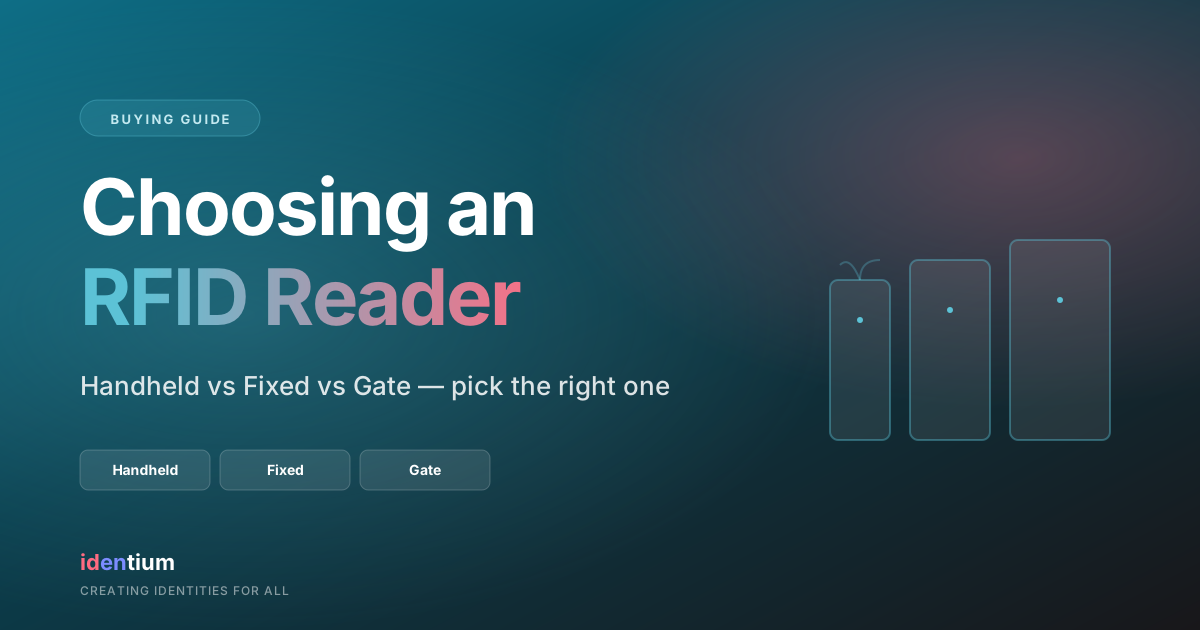
Every RFID deployment needs readers — but rarely just one type. This guide maps the four main reader categories, their specs, and the typical "reader mix" we ship for common use cases.
The four reader types
1. Handheld readers
What they are: mobile scanners roughly the size of a barcode gun, with an integrated UHF antenna, Wi-Fi/Bluetooth, and 4–8 hours of battery life.
Best for: audits, spot-checks, asset locate, mobile inventory.
Key specs to evaluate:
- Read range (typical 4–12 m)
- Battery life (prioritise 8-hour shifts without recharge)
- Rugged IP rating (at least IP54; IP65 for harsh environments)
- Android vs Windows OS
- Barcode/QR combo capability
Our recommendation: the CX1500N — Android 11, 8-hour battery, IP65, 12 m range, combo barcode. It's our most deployed handheld in Indian warehouses and retail. Handhelds are also what make a tool crib workable — see RFID tool tracking and our guide to crib control, calibration and MRO accountability.
2. Fixed readers
What they are: wall- or ceiling-mounted reader units with 1 to 16 antenna ports. They sit on a network connection (Ethernet or PoE) and run 24×7.
Best for: continuous monitoring of specific zones, shelves, workstations, or assembly lines. Permanent installations.
Key specs:
- Antenna ports (more = wider coverage per reader)
- Power over Ethernet (PoE) — simplifies cabling
- Onboard processing (edge filtering reduces server load)
- Environmental rating (outdoor, cold-chain, etc.)
3. Gate / portal readers
What they are: purpose-built reader assemblies with directional antennas positioned as a portal. Items passing through are scanned automatically.
Best for: dock doors, facility entries, checkout points, security gates, race finish lines.
Key specs:
- Aperture width (match to your widest load)
- Directional reads (ignore tags outside the portal)
- Sensor integration (photo-eye, weigh-cell, CCTV)
Our recommendation: Identium UHF gate reader — deployed at warehouse docks, race finish arches, and high-security facility gates. The same portal, fitted with a longer-range antenna and a boom-barrier relay, becomes a vehicle lane — covered in our vehicle and parking management solution and the RFID parking and vehicle access guide.
4. Desktop readers
What they are: compact, USB-powered readers the size of a thick paperback. Close-range (< 30 cm) reads.
Best for: tag encoding at manufacture or receiving, POS counters, registration desks, card issuance.
Our recommendation: Identium UHF desktop reader — USB, simple SDK, ships with every tag-encoding pilot. A desktop pad is also the entire reader story in a library self-issue kiosk — see our library management solution and the RFID library management guide.
The reader-mix recipes
Warehouse (50,000 sq ft)
- Gate readers at every dock door (12–20)
- Handhelds for associates (1 per 4 associates)
- Fixed readers at WIP handoff zones (4–6)
- 1 desktop reader for tag encoding
Retail store (3,000 sq ft fashion)
- 1 gate reader at entry/exit
- 2–3 handhelds for associates
- Smart fitting-room reader (1 per room)
- 1 desktop at POS
Hospital (200 beds)
- Gate readers at ward exits, OT, NICU, pharmacy (6–10)
- Ceiling antennas + fixed readers in high-traffic wards
- Handhelds for nursing stations (1 per station)
- Desktop readers at admission + pharmacy (4–6)
Event / conference
- Gate readers at registration entry, session room doors
- Handhelds for troubleshooting
- Desktops at registration counters
Antennas: the often-forgotten component
Fixed readers are only as good as their antennas. Common types: Increasingly the fixed reader is also the computer: see ReaderSense Edge, which runs the middleware on the reader board itself.
- Circular-polarised 9dBi: general-purpose, orientation-tolerant
- Circular-polarised 12dBi: longer range, tighter beam — for gate readers and high ceilings
- Linear-polarised: better for uniform tag orientation (e.g. conveyor belts)
- Near-field antennas: for close-range, dense-tag scenarios (jewellery trays)
Software compatibility
All Identium readers speak the LLRP (Low-Level Reader Protocol) standard, which means they work with every major RFID platform — ours included. Avoid vendors who lock you into proprietary interfaces; LLRP is the insurance against vendor lock-in.
India-specific considerations
- WPC / BIS certification — mandatory for UHF hardware sold and operated in India
- Power (230V/50Hz, surge-prone) — specify UPS + surge protection per reader
- Harsh environments — monsoon humidity, dust in industrial zones — IP54 minimum; IP65+ preferred
- Spare parts — buy from vendors with local stock; we keep all models at our Delhi warehouse
Reader frequency region
India uses the 865–868 MHz sub-band (regulated by WPC). Ensure all UHF readers are tuned to Indian/ETSI frequency range — readers from US suppliers often ship with 902–928 MHz FCC settings that won't pass WPC audit. The paperwork side — WPC ETA for import, where BIS registration applies and how to verify a reader's band setting before you sign — is covered in our RFID reader compliance checklist for Indian buyers.
Ready to spec your reader mix?
Tell us your use case and facility layout — we'll come back with a reader list, cabling plan, and quote. Get in touch. Full reader range at IndiaRFIDStore.com.